
Monster Hunter Outlanders Guide: Weapons, Controls and Progression Walls
Set Adventure or Classic controls, pick one of the eight weapons on your Fated Adventurer, and raise Ecological Rank so midgame gacha and power walls do not stall the hunt.
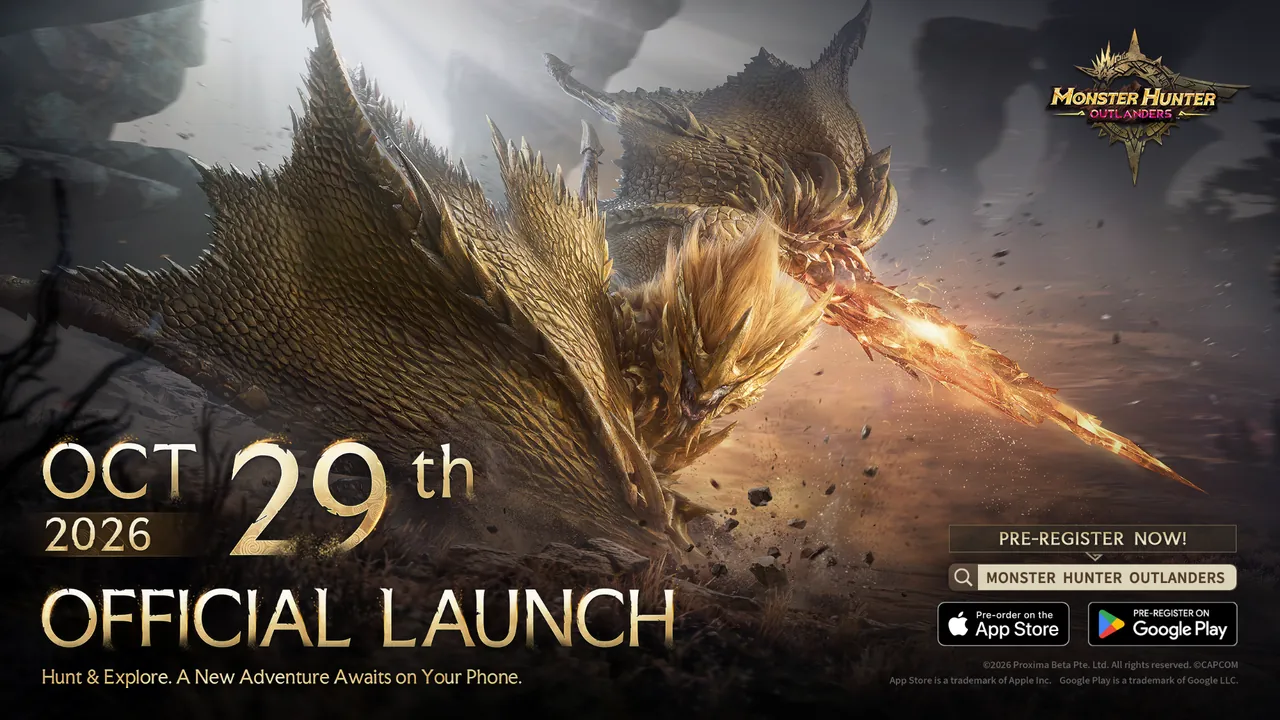
Monster Hunter Outlanders is TiMi Studio Group's free-to-play hunting game for iOS and Android, licensed by Capcom and launched October 29, 2026. Level Infinite publishes the global version; Garena publishes a separate version in other regions, and accounts do not transfer between them. You can hunt solo or in a four-player squad. This guide is the practical setup: how to set Adventure or Classic controls, how to pick a weapon without wasting materials, and which systems actually gate your power once the story starts to slow down.
A full starter walkthrough covering controls, weapons, ranks and early systems is below:
Set your controls first
Outlanders has two control schemes, and you can change them at any time in Settings.
Adventure reduces the hunt to three context-sensitive buttons: Attack, React, and Burst. Attack chains combos. React becomes a dodge, a guard, or another defensive option depending on the moment (a Heavy Bowgun, for example, can also swap to a more effective ammo type automatically). Burst is the big spend. In this scheme, monsters can glow red just before an attack; wait a beat, then press React if you want the dodge or counter. Adventure is the better fit on a touchscreen if you do not want to manage a full button layout mid-hunt.
Classic is closer to a standard Monster Hunter layout: Basic Attack, Skill 1, Skill 2, Skill 3, plus Evade and Sheathe. You choose every move yourself, including the order of skills that buff one another. It works on a touchscreen, but it is a lot to juggle with thumbs alone.
Mode and Controls are separate settings (Settings > Mode, and Settings > Controls). You can keep Adventure's combat hints and attack warnings while using Classic's full button layout, and you can move buttons on custom layouts for solo and multiplayer. Attack warnings also have their own toggle.
Controller support is available at launch for hunting, the quest system, and field exploration, with more features still being expanded. Classic plus a controller is the most comfortable way to play. Use Adventure if you are staying on a touchscreen.
The eight weapons, and how to choose one
The launch roster is Great Sword, Long Sword, Dual Blades, Hammer, Lance, Charge Blade, Heavy Bowgun, and Bow. More types are planned in later updates. Your Fated Adventurer (your created hunter) can use every weapon with its default moveset. Recruited Adventurers are locked to one weapon and their own unique moves.
Try weapons on the Fated Adventurer in the training area and the in-game weapon tutorials before you commit upgrade materials. All eight are viable. Spreading parts across several trees leaves all of them underpowered, so learn one weapon's timing first and switch later if you want.
What each type is built to do:
- Great Sword: slow, charged hits. A Perfect Evade can help you keep a charge instead of sheathing.
- Long Sword: build and spend a Spirit Gauge, with timed counters leading into finishers.
- Dual Blades: fast pressure, with Demon / Archdemon gauge management.
- Hammer: blunt stun damage, made to create openings.
- Lance: guard, poke, and counter, with a shield always in play.
- Charge Blade: Sword Mode to build phials, Axe Mode to spend them. See our Charge Blade guide for the full loop.
- Heavy Bowgun: heavy ranged fire; special ammo is limited and needs managing.
- Bow: mobile ranged play with charged shots and coatings.
There is no single best starter. If touch melee feels clumsy, Bow or Heavy Bowgun keep you at range. Lance is the most straightforward defensive melee option. Charge Blade is the most technical of the eight.
Adventurers, classes, and the gacha wall
Named Adventurers each have a fixed class as well as a fixed weapon: Assault, Support, or Disruptor. You can play as your Fated Adventurer or as a recruited hunter, and you also take squadmates on the hunt. Free SSR tracks already cover a Great Sword Assault hunter (Pyro, Adventurer's Chronicles) and a Bow Assault hunter (Luka, Surging Lightning). You do not need a limited banner to obtain those two. The full unlock steps, point thresholds, and Rank Rush SR grants are in our endgame guide.
The midgame slowdown is less about a single paywall and more about how many systems stack at once. Equipment, charms, Buddies, Insights, Visages, Adventurer Rank, Proof of Mastery, and Ecological Rank all climb on different tracks. The first stretch is generous with materials. Roadblocks show up later, especially when you try to power up additional gacha characters. You can keep playing without spending; money mainly speeds up that upgrade load. Story quests also expect your Adventurer Rank and Ecological Rank to keep moving, and some activities wait on daily rewards or stamina.
The practical answer is to main one hunter (your Fated Adventurer or one free SSR), put Insights and gear into that character, and raise Ecological Rank as soon as the next gate opens instead of splitting resources across a full roster.
How to raise Ecological Rank
Ecological Rank is the real power cap. It raises charm, Keepsake, and Buddy level limits, the star rating of field monsters, and which Hunt Request difficulties you can run.
Push Adventurer Rank until the next Ecological Rank is available, then clear the Proof of Mastery / Training Ground requirements and the Ascension Challenge. Do not sit on raw hunter rank after the gate is open. Eat a meal before the challenge, and craft weapons and armor from monsters you can already hunt at your current star rating; jumping a Hunt Request tier before the matching Ecological Rank usually wastes carts.
When a new difficulty opens, run it for the Keepsake, Buddy, and Visage materials listed there. Daily supplies, guild activity, and weekly hunts that pay power materials should come before optional grinding. For the full post-story loop and the permanent free SSR checklists, use the endgame guide.
Adventurer's Guild Campaign (through November 30)
The Adventurer's Guild Campaign runs October 29 through November 30, 2026. Join a guild and contribute to server-wide challenges; those targets unlock rewards for everyone on the server. Check the in-game event page for the current goal and claim window, and join before the campaign ends.
Related guides
- Endgame guide: fast progression, power and free SSRs
- Charge Blade guide: controls, combos and Power Axe Mode